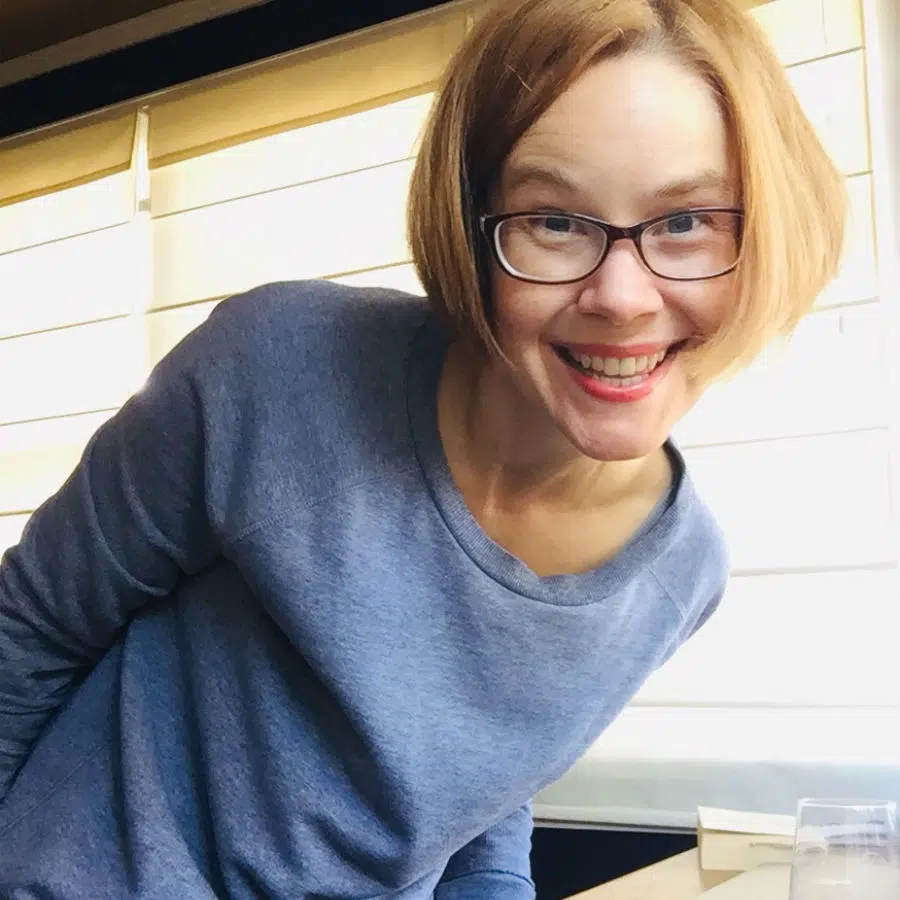
The Melon Head Mayhem author tells us why he decided to become a writer, what happened after he started reading Stephen King, and why expanding a short story into a Killer VHS novella was one of the best decisions he ever made.
Alex Ebenstein is the founder and owner of Dread Stone Press, an independent publishing house specializing in horror and dark speculative fiction. He’s also the author of Melon Head Mayhem, the first installment in Shortwave’s popular Killer VHS series—a collection of stand-alone novellas that Horror Obsessive recently dubbed “Goosebumps for adults.”
We asked Alex to share his thoughts on how he became a writer—and why he doesn’t put much stock into so-called “writing advice.” He also reveals how he developed Melon Head Mayhem, and why every author should have a trusted reader who can help them understand whether they’ve written what they set out to write.
How did you become interested in writing as a profession?
I was never the kid who believed he wanted to be a writer when he grew up, though I’d always enjoyed reading books. I also thoroughly enjoyed being creative and creating things—though I spent a lot of my life after childhood and into adulthood convincing myself that wasn’t the case. Or, rather, that it was not something I could pursue.
Then, during college, something changed. I don’t know what, exactly, but something clicked and the thought of trying to become a writer seemed like a thing I wanted to do. That was around the time I started reading Stephen King books, so perhaps that was the catalyst, but I also think it was the cumulative effect of having spent years (from high school into college) writing papers and realizing, hey, wait a minute, I might actually be pretty good at writing.
Everything had been purely academic (and often scientific) in nature up to that point, but it was evident that I had a fairly firm grasp on the principles of writing and grammar—despite never actually being taught grammar. At any rate, the idea was formed and I let it sit for another couple years until the end of my graduate school program when I had completed my thesis. Oddly enough, writing that was the final push I needed. The process had been much more enjoyable than I anticipated, and I thought, you know what? I can write, and I bet it’d be even more fun if I was writing made-up stuff.
Shortly after I wrote my first (terrible) short story, and within a couple years after that I’d written my first (probably terrible) novel. The rest is, well, whatever I’m doing right now.
What drew you to horror in particular?
The easy—and cliched—answer is: Stephen King. My parents both have been reading his books my entire life, so it was there, whether I truly noticed or not. And starting to read him myself in college was a bit of a revelation. I had only really read commercial thrillers and historical fiction as an adult, so reading King opened my eyes to the types of stories being written that really spoke to me.
Now, of course, when I look further into the past, to my childhood, I remember reading nearly all the Goosebumps books and loving Scooby-Doo, so really should it have been any surprise that I'm a spooky kid at heart?
How did you build your writing skills?
Early on it was reading Stephen King’s On Writing and listening to hours and hours of writing podcasts. Now, these days I’m not sure how much stock I put into “writing advice” resources, because none of it works for every writer, and frankly, a lot won’t work at all for you. However, it got me thinking about writing and what I wanted to write and how I wanted to try writing it. And that was invaluable, just getting into that “writer mindset,” whether that was ever a real thing or not, I felt like I was in it.
Beyond that, I did what everyone should do: read books and write stories. See what’s being done, how it’s being done, what works and what doesn’t, and then try it out for myself. You can’t get a true grasp of what works until you try to put the words down on the page. And, one of our greatest assets, our writer's voice, is best found and honed by simply writing. Get the words down and see what comes out of it.
What excites you about the Killer VHS series?
The Killer VHS Series is so cool to me because it leans so heavily on nostalgia and offers a chance to re-capture the fun of old school horror—but, almost as importantly, I think it’s an opportunity for us horror writers to inject our modern takes and our contemporary perspectives. This isn’t solely writing schlock for schlock’s sake—if I may be so bold—it’s a chance to explore fun, absurd horror plots with a little extra care given to what it means and what these characters are all about.
How did you develop your Killer VHS novella from first to final draft?
Melon Head Mayhem has a fun origin story, in my opinion. It started as a short story that I wrote back in 2019, when I was very much still a baby writer. I didn’t know where all to send stories to and was struggling to find ideas of my own, so I wrote the first version for a submission call that was any genre, so long as it started with the given first line: “Carlos discovered the _____ under a pile of shoes in the back of his grandmother’s closet.”
I, of course, inserted “VHS tape” into the blank, and must have recently been down a local urban legend rabbit hole—the melon heads—because I smashed the two thoughts/ideas together, and came up with the initial story idea. It existed as such for close to a year after, then I had the idea to expand it into a novella-length story. The best decision I could have made! It really allowed me to explore the melon heads more, dive deeper into this idea of “VHS brings the monsters to life,” and more fully develop the characters, who I had fallen in love with.
The novella went through a couple revisions before I ultimately submitted it to Alan at Shortwave, then from there received some excellent edits to strengthen the characters and fine-tune language. I’m proud of the final version that got published, and thrilled to see the story resonated so well with readers.
What advice do you have for other writers?
I kind of tipped my hand earlier on how I view writer advice, haha, but my go-to advice is to find a trusted beta reader if you can. My writing took a giant leap forward after establishing a close relationship with a beta buddy (who could be a freelance editor easily, she’s so good). Of course, with all advice, your mileage may vary. Everyone’s writing style and process is different, and a beta reader may not be in the cards. But, for me, I need that outside perspective. I need someone to challenge some of my decisions (if only to reaffirm what I wrote is what I want). I need the encouragement, too.
Being a writer is a solitary endeavor in large part—but finding a way to make it a little less so has been instrumental in my progression.