
John Langan is the author of two novels and six collections of stories. That previous sentence is a direct lift from the biography he provided me for this opening. As far as understatements go, it’s an impressive. Langan is a master of the short story whose collections never grow stale and showcase an evolving, yet supremely confident author who has fun playing with the weird, the horrific, and the phantasmagorical. His novel The Fishermanis quite rightly considered a modern classic of weird horror. Not only that, but he is a warm and welcoming presence online and at events, giving freely of his time,insights, and wicked sense of humor.
For his work, Langan has received the Bram Stoker and the This Is Horror Awards. He is also one of the founders of the Shirley Jackson Awards, and continues to serve on its board of directors. He lives in New York's mid-Hudson valley with his wife, younger son, and an office filled with stacks of books that are competing over which one will fall on and crush him first.
Before such crushing could occur, I was very fortunate to chat with him about his favorite author.
Who is your favorite author and why?
Today, it’s Salman Rushdie. While there have been individual novels I have admired more, taken together, Rushdie’s body of work rivals the best anyone has produced.
I’d like to dig a little deeper here, regarding the decision-making process. With this column, I fully understand that the notion of “favorite” is not always consistent from interviewee to interviewee. Nor should it be! For you, it seems that favorite can align with the corpus of an author, a sort of cumulative production amounting to a greater whole. Is that fair to say? As someone who’s quite prolific in their publishing, quickly approaching more short-story collections to your name than most folks have fingers on two hands, do you want readers to consider your work as a whole as your ideal path for reader appreciation?
That's a fascinating question, and a distinction I haven't really thought about before. There are individual works I love--say, William Kennedy's Ironweed, which I once named as the book I would like to be buried with. That's pretty strong praise. But while I liked the other novels by Kennedy I read, none affected me in the same profound way Ironweed did. So, in speaking about Kennedy, I might say that he wrote one of my favorite books, but not that he is one of my favorite writers.
When I think of writers I would describe this way--Rushdie, or Straub, or Faulkner--there's definitely an element of consistency over a span of books that enters into consideration. These writers--and others like Cather, James, and Dickens--have each written a number of my favorite novels and stories. (The same thing holds true for poets such as Rilke, Yeats, and Dickinson.) You could say it's a case of the whole being greater than the sum of its parts.
As far as my own work goes: yes, I would be happy for it to be taken as a whole. I haven't braided it together with the care a friend like Laird Barron has his fiction (indeed, Laird seems to me one of those writers who really lives inside his work). There are connections among several of my stories and novels; although there are at least as many that exist in their own space, whose principal links are those of geography, of being set somewhere in the vicinity of the Hudson River valley. I suppose they're linked, too, by a certain restlessness of technique: I'm interested in trying different things in my fiction. Some years ago, a commentator on my stories compared them (very generously) to Ray Bradbury and T.C. Boyle's, saying that, as in the case of those other writers, you never knew what you were going to get when you sit down with one of my stories. That's a compliment I've been trying to live up to ever since.
So, to bring things full circle, the example of a writer such as Rushdie is what I'm striving for.
When were you first made aware of Rushdie and when were you first drawn to his work?
As was the case with so many readers, I became aware of Rushdie when the fatwa was issued against him by the Ayatollah Khomeini for his novel, The Satanic Verses. I was an undergraduate in college at the time. Of course, I was interested in a novel that provoked such an extreme response. Shortly thereafter, I was in my local bookstore when a couple of copies of the book arrived. I bought it on the spot and carried it out in a plain brown paper bag, feeling very brave. I started to read it right away. It’s a book that begins with a literal bang, an explosion that tears apart a jetliner and sends two of its passengers tumbling through the air, singing to one another. (I would later learn that Rushdie had used an actual terrorist event in his novel.) The men land, miraculously unhurt though not unchanged, and the narrative that follows is full of transformations, of men and women crossing the line between human and angel, human and devil, human and monster. I had read Becket and Pinter in high school, and a few stories by Barth and Borges in college, but not really anything like this. Most of the fiction I read for school was twentieth-century Modernist, which is to say, experimental within certain parameters of style and form, but in terms of subject matter basically realist. I had also read traditional fantasy like Tolkien, Lewis, and Howard. In its blend of the mundane and the fantastic, Rushdie’s novel had more in common with the work of the writers whose work I had devoured in high school, King and Straub and Klein. But it pushed all sorts of boundaries in terms of character, event, tone, and style, and I was terribly impressed with the result. At the time, I knew I didn’t understand everything I had read (an experience I’d had with Peter Straub’s fiction when I first encountered it), but this did not bother me. It meant there was more for me to go back to—which I did.
I’m a big fan of that sense of exploration and enrichment that comes along with reading a book or story that may go slightly over the head or introduce new concepts. It reminds me of reading reprints of the Stan Lee/Jack Kirby Marvel Comics and getting the dictionary out to cover some of Lee’s verbosity. In The Satanic Verses, you seem to have found that level of exposure to something new, taken to the next level. What do you find so appealing about this? As writers are we more inclined to be open to these challenges? Or is it a more universal trait?
I don't think that openness is necessarily the province of writers: to cite your example of Lee and Kirby's florid vocabulary, look at how popular those comics were. I remember my delight at the rhetorical excesses of those Marvel comics, at the way they pushed the limits of language and of visual design. (I had the same response to Alan Moore's work on Swamp Thing, and later Watchmen and V for Vendetta.) (Which, needless to say, were also extremely popular.) I do recognize in myself a particular fascination with and delight in those texts that cross borders, whether of style, technique, subject, or genre. In those texts, meaning proliferates--yet there are also areas of mystery. I want to call them blank spots, but that isn't quite right: it's more that hints of meaning come into view, like the edge of a great beast glimpsed behind a mountain. I sometimes think these mysteries are generated by the intersection of all those different elements; at other times, I think those intersections just help to highlight them.
Is there one particular piece of work from Rushdie that you are especially fond of, or that’s had a significant creative impact on you? What is that piece and what makes it so appealing or affecting for you?
I’ve returned to Rushdie’s novel, The Moor’s Last Sigh, many times. As with many of his books, it’s a family saga. It’s deeply interested in questions of art and artistry and also of politics and history—indeed, it weaves all of them together. Its narrator is the kind of figure Rushdie has employed repeatedly in his fiction, someone who is close to the center of power but simultaneously separate from it: in this case due to an abnormal rate of development that causes him to age at twice the normal rate. There’s a tendency to read the novel as Rushdie’s extended response to Khomeini’s death-sentence, and while that’s certainly at play in the narrative (as how could it not be?), this seems to me an oversimplification of a complex plot and characters. As with so many of Rushdie’s longer narratives, there is at the heart of the novel a reckoning with the self and with family and with the relationship between these two poles. In general, I appreciate Rushdie’s work for its expansiveness, its refusal to embrace the cramped minimalism that continues to afflict a certain strain of contemporary fiction. The Moor’s Last Sigh is a brilliant, moving instance of another way to approach fiction.
I’m also very fond of The Ground Beneath Her Feet, Rushdie’s rock ‘n’ roll novel, which contains possibly the greatest title of an invented album ever: Quakershaker (How the Earth Learned to Rock & Roll).
How often do you revisit Rushdie’s work? What lessons have you learned at various times from his writing?
I tend to make my way back to Rushdie’s fiction at least every other year. A couple of years ago, I decided to alternate (re)reading Rushdie’s fiction with that of V.S. Naipaul, using as a kind of cleanse for the other. It was a terrific exercise, each writer’s style helping to highlight the particularities of the other’s. From the first time I read him, I loved Rushdie’s long sentences, his willingness to break the fourth wall and address the reader directly, his willingness to digress, his inclusion of the fantastic in his work, the range of his literary, cultural, and historical allusions. With time, that’s only become more true. I think I’ve also become more aware of the manner in which he makes use of the mundane, even autobiographical in his fiction. And I’ve learned that it’s possible to continue to grow as a writer as you age.
On that autobiographical front, I (and I suspect many others) love the author notes that are a staple of your short-story collections. In these essays in miniature, you often call out events from your own life, your career, your reading that served as either the spark for the story or that may even stand as the spine of a piece. Combined with that last insight about continuing to grow as a writer as you age, do you find it easier to share more of yourself and your life via stories today? How do you approach that alchemy between experience and the purely invented?
There have been autobiographical elements in my fiction since my first published story, "On Skua Island," which appeared in 2001. (If I look back over what I wrote before that, it was full of autobiography, too.) Indeed, when I consider the contents of my first collection, Mr. Gaunt and Other Uneasy Encounters, I'm struck by how much of my life I put into those early stories. The same thing is true for my first novel, House of Windows, which I was writing around the same time. I guess I've taken pretty seriously the advice to invent from what you know. In a number of cases, this has entailed mining my life, or at least, aspects of or moments in my life for material. It's also involved leaning into my interests and obsessions. Throughout my fiction, you'll find references to and dramatizations of father-son relationships, especially difficult or damaged ones. You'll find monsters. You'll find an interest in male friendship. You'll find references to the wars the US has fought since 9/11. You'll find descriptions of the landscape and history of the Mid-Hudson Valley. You'll find references to religion and myth, to history and rumor. My family is in there, sometimes directly, sometimes in disguise; the same is true for my friends and acquaintances. A few favorite dogs, too.
Are there any pieces in Rushdie’s oeuvre that have not worked as well for you? If yes, which ones and why do you think the connection was not as strong?
I wouldn’t say that there’s anything of Rushdie’s I haven’t liked, but I have benefited from re-reading all of his work. The first time through, I’m following the developments of the plot, and not always picking up on other things going on in terms of theme and symbol. The second time, I’m more attentive to the nuances and subtleties of Rushdie’s writing. I’ve returned to Shame, The Satanic Verses, The Moor’s Last Sigh, and The Golden House repeatedly and have been rewarded every time. (There is of Rushdie’s novels I’ve never finished: The Enchanter of Florence, but that was because I was enjoying the book so much, was so delighted in it, that I didn’t want it to end, and so made the decision to stop where I was and leave the rest undiscovered. I imagine I’ll resume it at some point.)
I love that bit about The Enchanter of Florence so much. I’m very much the same with the works of many of my favorites. I just don’t want to read the “last” thing from them and would prefer to always have a little something extra waiting in the wings, like “Break Glass in Case of Existential Emergency.” There’s no question here, just a sign of respect. But if you do want to expand a bit on that process of reading and reaching the decision to save (and savor) the experience, well, I won’t stop you.
I'm pretty sure the first time I read about anyone doing this was in an interview with John Irving, who was speaking about his abiding love of Dickens's novels. But although he had read all of them multiple times, there was one book he had kept in reserve, as it were. (I believe it was Our Mutual Friend.) This way, he knew he had not read everything; there was still more of his favorite writer waiting for him. I tend to be more of a completist; at least, I haven't restrained myself from reading anything for the same reasons.
Or perhaps I have. Irving's desire was to prolong his experience of a writer's oeuvre. Mine is to prolong the experience of a single novel, each of whose chapters delighted me to such a degree, I preferred to remain in the midst of it. Maybe there's an element of fear in my decision, an anxiety the remainder of the novel won't live up to what I've read? It's possible. But I think of it more as wanting to extend the joy reading the novel brought me.
What writing lessons have you taken, purposefully or accidentally, from Salman Rushdie?
To be restless and bold in your writing, to never stop reaching for more than you think you can grasp. To rummage and ransack your influences for whatever is useful to the piece you’re working on. To read widely and eclectically, and by reading, I mean engaging with culture in all its myriad forms: fiction, non-fiction, film, music, fashion, food, and politics. To embrace the ridiculous, the absurd. To be unafraid of long sentences, of lush description, of excess, of saying what it is you mean. To dig deeply into the things that matter to you and to include them in your work. To not neglect the stuff of your life.
Are there specific stories in your catalogue that you feel best live up to these lessons?
In a broader sense, I would hope that all my work at least approaches the boldness and ambition of Rushdie’s fiction. For things that are more directly indebted to him, I would suggest maybe my novels, House of Windows and The Fisherman, and possibly my short novel, Sefira, and perhaps my novellas, “Mother of Stone,” “Lost in the Dark,” and “Altered Beast, Altered Me.”
If a reader wanted to start reading Salman Rushdie, what piece would you recommend they start with?
I think Rushdie’s strongest work has been at novel length. His third novel, Shame, is on the shorter side, and offers a more concentrated example of his virtues. For anyone willing to try a longer novel, I would recommend taking a look at Midnight’s Children (his most celebrated book), The Moor’s Last Sigh, or The Enchanter of Florence.
If you could ask Rushdie one question about his work, what would it be?
If I could talk to Salman Rushdie, I would thank him for everything he’s written, for the profound gift of his art and for the richness it has brought to my life.
If I were to ask him anything, it would be how he’s managed to maintain his ambition and enthusiasm for writing over what has become a very substantial career.
What do you have coming out next on the writing and publishing front? What are you working on now?
Currently, I’m at work on two novels. The Brides of Crom is a Conan tie-in novel in which the young Conan and his cousin, Ruarhidh, investigate the circumstances of his famous birth on a battlefield, an event no one in his village wants to speak of, not even his parents, and which leads the two of them to the northern mountains of Cimmeria, where they discover terrible things. The second book is called The Cleaving Stone, and it’s a (very) loose follow-up to The Fisherman. It concerns the fate of Dennis Mitre, a famous anthropologist who went missing some ten years before on the trail of a cryptid called the Catskill Devil. No trace of Mitre was ever found, and although his wife had him declared dead, there has been no definitive proof of it. When a message seems to indicate that he is in fact still alive, a group of his children and former students head into the Catskills to investigate it. I’m hoping to have both novels done this year, and for them to see the light of day in early 2027. In the meantime, I’ll have a story published at Reactor in the spring called “This Fleshy Side of the Bone,” and another story, “The Auld Woman with the Broom,” appearing in Ellen Datlow’s Halloween-themed anthology, All Hallow’s Eve, in the fall.
Thank you for taking the time to chat with me about your favorite author.
Thank you for inviting me to do so!
Where can readers find you online?
I keep an intermittently updated blog at johnpaullangan.wordpress.com. Otherwise, I spend too much time at the usual social media sites (Facebook, Bluesky, Threads, and Instagram--not Twitter, though. I have some standards).
Enjoy this story? Consider supporting our magazine with a small donation.
All donations will go towards paying authors for new stories, or website upkeep to ensure our stories remain free to read.
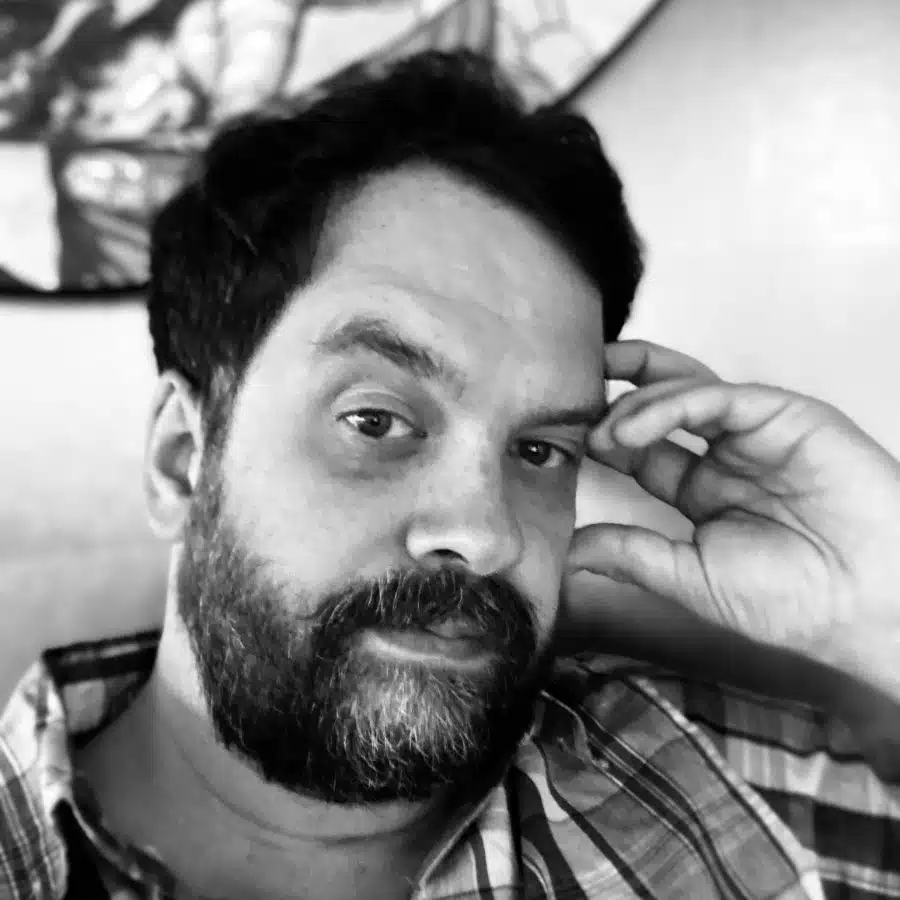
Patrick Barb is the Bram Stoker Award-nominated author of weird, dark, and spooky tales, currently living (and trying not to freeze to death) in Saint Paul, Minnesota. His published works include the sci-fi/horror novel Abducted; dark fiction collections The Children’s Horror and Pre-Approved for Haunting; and the novellas The Big One, The Nut House, Night of the Witch-Hunter and JK-LOL. He is the editor and publisher of the anthology And One Day We Will Die: Strange Stories Inspired by the Music of Neutral Milk Hotel. His interview column “Your Favorite Author’s Favorite Author” appears regularly online in Shortwave Magazine. In addition, his 2023 short story “The Scare Groom” was selected for Best Horror of the Year Volume 16.
Copyright ©2026 by Patrick Barb.
Published by Shortwave Magazine. First print rights reserved.
We believe in paying writers professional rates. We also believe in not hiding stories behind paywalls. These two beliefs are, unfortunately, at odds with each other. However, your support today could help us continue our mission.
We respect your privacy. We will never sell your information. You can unsubscribe at any time.


