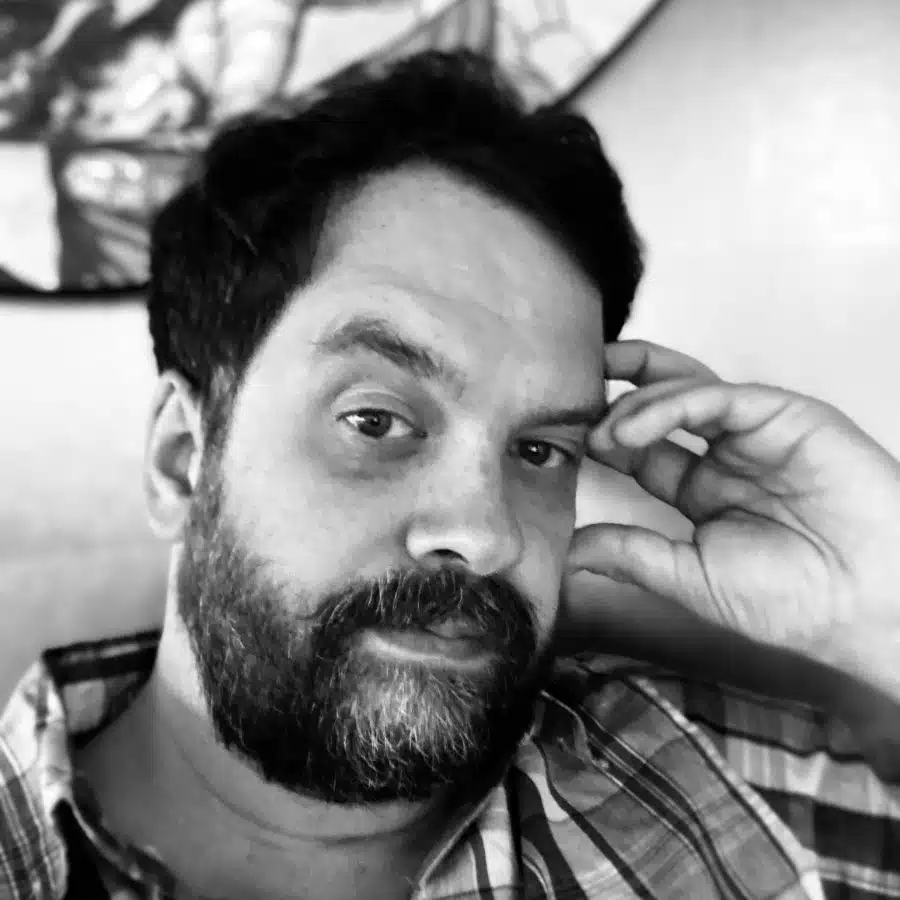
Robert P. Ottone is a two-time Bram Stoker Award-winning author from Long Island. He is the author of the novels Amityville Awakens, The Vile Thing We Created, The Triangle, There’s Something Sinister in Centerfield and the collections Tear Me Open: Fears Unwrapped and Her Infernal Name & Other Nightmares.
He lives in upstate New York with his wife, where he enjoys cigars, video games, film, and a good cocktail. He is represented by Stephen Barbara of InkWell Management.
That is all wonderful information and well worth knowing. But I think something else I like, no, love, about Robert is his passion. He cares deeply and fully. You can see that in his award-winning writing, in the way that he speaks about the people he cares for, and in the warm, welcoming presence that he presents at book events like StokerCon. It’s easy to feel like an old friend in his orbit. Which, come to think of it, is not too dissimilar to the vibe of his choice of favorite author.
Who is your favorite author and why?
John Langan is the guy whose work inspired me to try and write horror, for better or worse. You can blame him. He strikes such an interesting balance between literary and accessible with his work that drew me in immediately, but there’s also a true breadth to his creativity that’s staggeringly brilliant. He can, at once, unsettle you with supernatural body horror, then give you full-on cosmic terror while playing around with everything in between.
I learned early on that I could never mimic the authors who inspire me, but in my mind, I’m always chasing Langan for how much he inspires me and how much his work means to me.
That notion of not being able to mimic the authors that inspire you is an interesting one. While I wouldn’t say that he mimics anyone, I do think that Langan has always been very honest and open about his sources of inspiration, even going so far as to mention in his Story Notes when he was trying to “write a story like X. How do you mark the distinction between mimicking and “inspired by,” and do you think you’ve written anything that trends toward the latter in regards to Langan’s influence?
Great question. Mimicking I think is evident in one trying to utilize language, terminology or themes that may not traditionally be present on their work. “Inspired by” is a better term and probably the better route to take. I have a piece coming out (alongside Monique Asher and Alyssa Alessi, with Sobelo Books) called “Schlocking” that’s part of our Triptych of Terror: 1998, and my story in there is “inspired by” Nathan Ballingrud in a big way. So, while I would never have the flourishes of a Langan or Ballingrud, I can still feel inspired to push toward that in some way.
When were you first made aware of John Langan and when were you first drawn to his work?
I went on Reddit and was poking around the various horror literature and horror book groups on there. I kept seeing all the usual suspects mentioned, until, finally, I came upon a thread talking about the best short story collections in recent years. One of them was Sefira & Other Betrayals by John Langan.
I bought the book immediately (along with Brian Evenson’s Song for the Unraveling of the World) and devoured both, but Sefira was the one that’s stayed with me longer. There’s really not a day that goes by that I don’t think about the story “The Third Always Beside You,” which handles grief, lust, and body horror in such a way that I’ll never forget it. While Sefira itself gets a lot of love, “The Third Always Beside You” is the one that I read and go, “Damn.”
I find myself drawn to Langan’s work for a variety of reasons, but I think it’s how widely he treads in the genre that interests me. He’s one of the few authors who, whenever he has something out, I buy it immediately because it’s a legitimate “must-have.” I just have a need to see what he’s doing. It’s not about determining the way he constructs a story, it’s not remotely that, it’s just pure storytelling for me.
It’s funny. I have been running this column for something like two years now, and this is the first time someone has brought up Reddit as a resource for horror author recommendations. And yet, I know plenty of folks who are regulars in those horror subreddits. Indeed, I feel like Langan is one of the contemporary authors who enjoys the most attention from the Reddit audience. Do you have any theories about why his work might connect with those particular audiences more than the work of other contemporaries?
To be fair, you also see the same people on there over and over. There’s also the usual Bookstagram suspects that get mentioned on Reddit all the time, too, albeit usually in a more negative fashion than I would care to indulge in reading, as some of these people are friends.
I think Langan’s work resonates because he hits with everyone in one form or another. Even the times I’ve read “negative” takes on his work, the reviewer always posits that they enjoyed the story, they just didn’t like one aspect or element of it.
They are, of course, wrong.
Is there one particular piece of work from this author that you are especially fond of or that’s had a significant creative impact on you? What is that piece and what makes it so appealing or affecting for you?
I mentioned that short story, but I’d be an idiot if I didn’t mention the obvious one.
[Langan’s novel] The Fisherman.
I have read The Fisherman multiple times at this point, and again, it’s never about “studying the craft” or whatever author-y nerd types say. It’s about engaging with the story. It’s about enjoying the narrative.
I don’t like to go on vacations. I just don’t. I get nothing out of it. But I get everything out of re-reading the works that inspire me or re-watching the movies that push me forward. The Fisherman is one of those, and I maintain that everything we do as horror authors is the buzzing of flies to the monolithic masterpiece that is The Fisherman.
We could spend the next 100 years of our lives trying to top The Fisherman, and we never will. Sorry. We just won’t. But the point is that we try. If we try to push ourselves further and find inspiration in the things we love, then that’s enough, I think, for writers. For me, it’s The Fisherman. It may be something else for you, and that’s awesome.
How often do you revisit The Fisherman or Langan’s work in general? What lessons have you learned at various times from his work?
I re-read The Fisherman at least once a year. Usually in the summer. The experience unfolds differently for me each time, and usually brings out emotions in me that I either haven’t explored in a while, or ones that were just bubbling under the surface. I usually cry. I usually meditate on the things I’ve lost. I meditate on the things I am fortunate to have. It’s a book that really turns everything inward, if that makes sense?
I think harder about myself. I think about what I do. I think about the world around me differently. I see it a little different.
I haven’t been fishing in a long time, either.
That totally makes sense. In your response and takeaway from The Fisherman, I’m reminded of an earlier conversation with Hailey Piper on Carmen Maria Machado. Piper also chose to focus more on the emotional experience/impact of reading the work over specific writing lessons. When you step back and look at your enjoyment of Langan’s work, are you finding that it falls more on the side of you as reader than as fellow writer?
I read solely as a fan. I’m not looking specifically to learn anything from anyone. I think that can be a trap. “Learning” something here or there might indicate to your potential audience that you’re making a go at aping a particular author’s style, and that’s not the vibe I cultivate. I always read as a fan and reader first, even if I’ve never read the person’s work before. Then, if I love it, I’m a fan for life. Or until they say something stupid on social media or get themselves cancelled for being a sex pest or whatever.
Are there any pieces in the author’s oeuvre that have not worked as well for you? If yes, which ones and why do you think that connection was not as strong?
I would say that Langan’s work as German Godzilla can often be controversial and I think the author would agree with me on that.
He is the Man of a 1000 Voices or, well, really just the one voice, ja?
I’ve said this before, but my dream would be to do my David Lynch impression on the Lovecraft eZine, with Michael Cisco doing his Werner Herzog and Langan doing his German Godzilla.
What writing lessons have you taken, purposefully or accidentally, from your favorite author?
I find myself wanting to experiment more. I see a lot of authors doing the same things over and over, and that’s lovely, but I don’t want to do that. I think that comes from Langan. Like I said, he goes all over the place, experiments with genre and expectation, and I like that. I think that’s the number one thing I’ve taken from his work and his career overall, to just … do things. To try new things.
Are there any works in your bibliography that you feel are closest to the work of your favorite—whether in terms of style, subject matter, length, etc.? Talk a little about those similarities.
I would never compare my work to the artists I admire. I find that gross, but if I were to say if there was something more overt from Langan’s influence on my own writing it would be the aforementioned experimentation. My book The Vile Thing We Created (Hydra Publications) was written as an upstate New York love letter in many ways, with heavy reliance on the Hudson Valley and Orange County regions of the state, similar in ways to The Fisherman I suppose.
My new book, Amityville Awakens (CLASH Books), is very much a wider story of a town dealing with something supernatural and strange. There’s some Langan in there in more ways than one, but more specifically, his approach to the realities of a supernatural event. I find that space thrilling. How do normal people react to paranormal circumstances?
Where does your writing diverge from your favorite author’s? Are there any elements from your favorite author’s work that you would like to incorporate in your own? If yes, what are these?
If I could steal Langan’s precision and beauty of language, I would. I’d give anything to be able to write as well as Langan, [Paul] Tremblay, [Linda] Addison, the people who inspire me, but I can’t. I’m not that guy. There are certain flourishes of prose that I wish I could bring to my work, but I just can’t do it. My memory isn’t what it used to be, and my brain doesn’t work as well as theirs do. I struggle with some pretty basic stuff sometimes, and I highly doubt the masters struggle with those things, so if I could somehow bolster my language and precision in the way Langan writes, that would be clutch.
In this divergence, coming from a place where you are less reliant on precision or beauty of language, do you find that there are other aspects of your writing that bolster the work in lieu of those touches? I suppose my underlying question here is what do you feel like your strengths are, especially those that may lie outside what you’ve cited as Langan’s strengths?
I think I’m pretty good at dialogue. I have an ear for how actual human beings speak and interact with one-another. Especially younger people. I think that comes from being a teacher, I hear them all day, and while a lot of their lingo makes no sense to me, there’s still the reality of interaction that’s always there.
I’ve also been told that I write to the senses really well. That when reading my work, people can smell and taste what’s going on, which is a weird, but cool compliment to receive, so I’ll take it.
If a reader wanted to start reading your favorite author, what piece would you recommend they start with?
I think short story collections are always a great place to start. It’s like a Whitman’s Sampler of their abilities, so I’d say pick up Langan’s Lost in the Dark and Other Excursions. You’re going to get the aforementioned wide range of storytelling, all of it told beautifully by the modern master.
If you could ask your favorite author one question about their work, what would it be?
“What is something you haven’t yet done that you really want to do?”
What do you have coming out next on the writing and publishing front? What are you working on now?
My book Amityville Awakens will be out soon courtesy of CLASH Books. I hope you preorder it or buy it immediately upon reading this, and think that I’m not the worst person you’ve ever read an interview with.
I am currently working on my first non-fiction work, while slowly piecing together an outline and notes on my next fictional piece.
Thank you for taking the time to chat with me about your favorite author. Where can readers find you online?
You can find me on Instagram (@robertottone) and Letterboxd (RobertOttone).